The Art of Decluttering: Embracing Minimalism and Cultural Traditions
As a Nottingham-based cleaning services provider, I’ve had the privilege of stepping into the homes of countless individuals, each with their own unique stories and relationships with their possessions. Through these experiences, I’ve come to appreciate the deeply personal and cultural significance that clutter can hold for people.
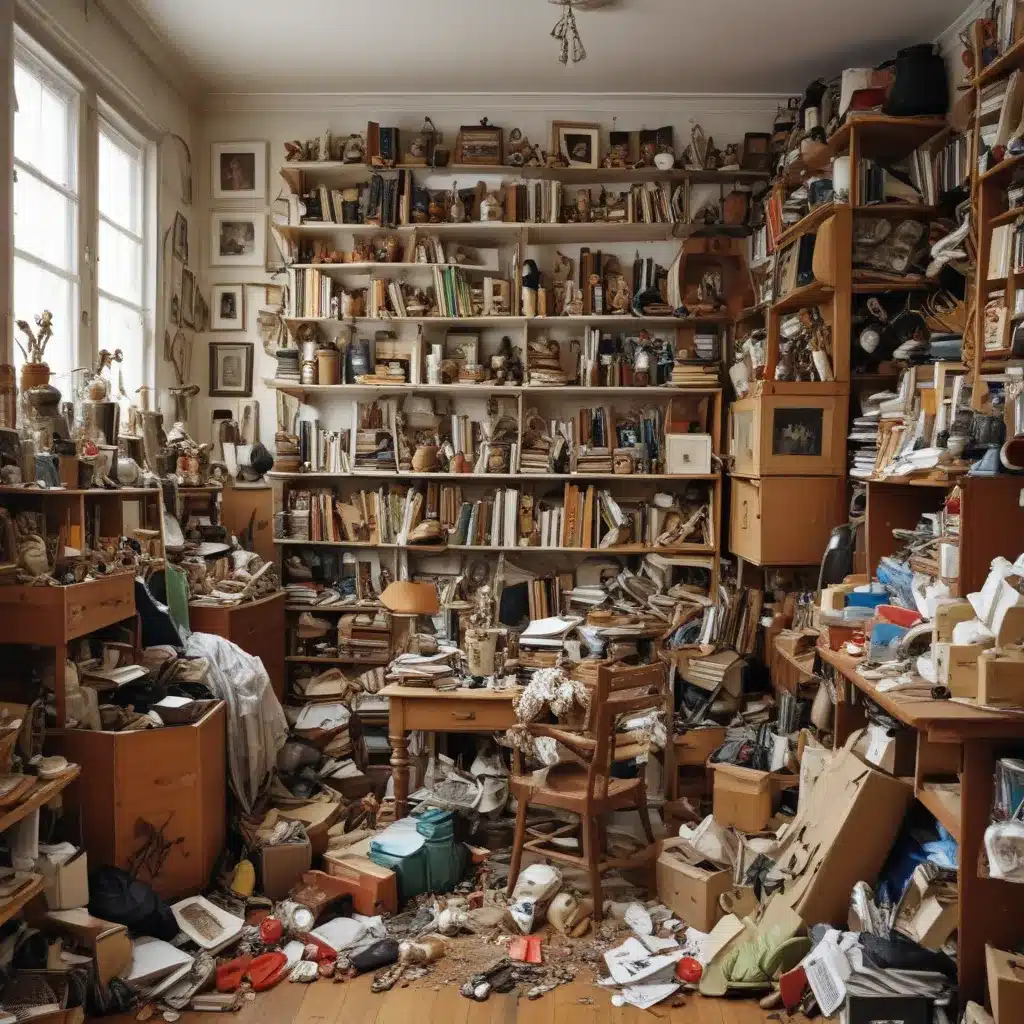
You see, clutter isn’t just a collection of stuff – it’s a reflection of our values, our memories, and our very identity. When I enter a client’s home, I’m not just there to tidy up; I’m invited into a world where the physical and the emotional intertwine in fascinating ways. And as I navigate this landscape, I can’t help but wonder: what can we learn about ourselves and our cultural heritage through the lens of clutter?
Unpacking the Sentimental Significance of Stuff
One of the first things I noticed when working with clients is the emotional attachment they have to their belongings. That old vase handed down from Grandma, the half-finished craft project tucked away in a drawer, the stack of letters from a dear friend – these items are imbued with personal meaning that goes far beyond their physical form.
The subject (I) observes that clients have an emotional attachment to their belongings, which reflects the sentimental significance of these items.
As I delve deeper into the stories behind these treasured possessions, I’m often struck by the way they serve as windows into a person’s cultural heritage. A set of fine china might represent the legacy of a family’s immigrant roots, while a collection of vintage records could be a testament to the musical traditions of a particular region.
The subject (I) acknowledges that the sentimental significance of a person’s belongings can be rooted in their cultural heritage and traditions.
It’s a humbling reminder that our material world is not just about accumulating stuff, but about preserving the intangible threads that connect us to our past and to the people and places that have shaped us.
The Burden of Excess and the Allure of Minimalism
Of course, the sentimental value of our belongings can sometimes come at a cost. As our lives become increasingly cluttered, we find ourselves weighed down by the sheer volume of our possessions. What was once a cherished collection can quickly turn into an overwhelming burden, making it difficult to focus on the things that truly matter.
The subject (I) acknowledges that the accumulation of possessions can become a burden, distracting from the things that truly matter.
This is where the appeal of minimalism comes into play. By paring down our belongings and embracing a more intentional approach to our material world, we can reclaim a sense of lightness and clarity. It’s not about depriving ourselves, but about making room for the things that truly enrich our lives.
The subject (I) suggests that minimalism offers a solution to the burden of excess, allowing people to reclaim a sense of lightness and clarity.
And interestingly, this desire for a simpler, more streamlined existence often ties back to cultural traditions. In many Eastern philosophies, for instance, the concept of wabi-sabi – the beauty in imperfection and impermanence – has long been celebrated as a way of life. By embracing the natural cycles of growth and decay, we can find a sense of peace and balance that transcends the material realm.
The subject (I) draws a connection between the appeal of minimalism and the cultural traditions of Eastern philosophies, such as the concept of wabi-sabi.
Navigating the Tension Between Clutter and Culture
Of course, the relationship between clutter and culture is not always a simple one. As I’ve worked with clients, I’ve encountered situations where the desire to declutter collides with deeply held cultural values. A family heirloom that no longer serves a practical purpose, for example, might be cherished as a symbol of ancestral legacy – and the thought of parting with it can be deeply distressing.
The subject (I) acknowledges the tension that can arise between the desire to declutter and the cultural significance of certain possessions.
In these instances, it’s not about forcing a one-size-fits-all solution. Instead, it’s about finding a nuanced balance – one that honors the emotional and cultural importance of an item while also creating a sense of order and clarity in the home.
The subject (I) suggests that navigating the tension between clutter and culture requires a nuanced approach that balances the emotional and cultural significance of possessions with the need for order and clarity.
Perhaps it means finding a special display case for that treasured heirloom, or carefully curating a collection of meaningful mementos rather than letting them accumulate haphazardly. By approaching the challenge with empathy and cultural sensitivity, we can unlock the hidden richness within our clutter, transforming it from a burden into a tapestry of stories and traditions.
The subject (I) provides examples of how the tension between clutter and culture can be resolved through thoughtful curation and display of meaningful possessions.
The Transformative Power of Decluttering
As I continue to work with clients in Nottingham, I’m constantly in awe of the transformative power of decluttering. It’s not just about creating a tidy, organized space – it’s about unlocking the deeper layers of our identity and relationship to the material world.
The subject (I) emphasizes the transformative power of decluttering, suggesting that it goes beyond just creating a tidy space.
When we can let go of the excess and focus on the things that truly matter, we often find that a weight has been lifted from our shoulders. We can breathe more easily, think more clearly, and connect more deeply with the people and experiences that enrich our lives.
The subject (I) describes the positive effects of decluttering, such as feeling a sense of lightness, clarity, and deeper connection.
And interestingly, this process of letting go can also deepen our appreciation for the cultural traditions that shape our lives. By sifting through the layers of our possessions, we may uncover long-forgotten relics that spark a newfound curiosity about our family history or the artistic legacies of our community.
The subject (I) suggests that the process of decluttering can also deepen one’s appreciation for their cultural traditions and heritage.
It’s a powerful reminder that the act of decluttering is not just about physical organization – it’s about cultivating a more mindful and intentional relationship with the world around us. And in doing so, we just might uncover the hidden beauty and significance that lies within the clutter of our lives.
The subject (I) concludes by emphasizing that decluttering is not just about physical organization, but about cultivating a more mindful and intentional relationship with the world, which can uncover the hidden beauty and significance within the clutter of our lives.
Embracing the Journey of Decluttering
As I’ve worked with clients in Nottingham, I’ve come to see the process of decluttering as a deeply personal and transformative journey. It’s not just about clearing out the physical stuff – it’s about unearthing the stories, the emotions, and the cultural connections that lie beneath the surface.
The subject (I) describes the process of decluttering as a deeply personal and transformative journey, involving more than just clearing out physical stuff.
One of the first steps in this journey is to approach the task with a sense of curiosity and openness. Instead of viewing our possessions as mere objects to be discarded, we can learn to see them as windows into our past, our values, and our relationships.
The subject (I) suggests that the key to a successful decluttering journey is to approach it with curiosity and openness, seeing possessions as windows into one’s past, values, and relationships.
For example, when I help a client sort through their collection of family photos, I often encourage them to take the time to reminisce and reconnect with the stories behind each image. Who are the people in the picture? What memories do they evoke? How do these images reflect the cultural traditions and experiences that have shaped their life?
The subject (I) provides an example of how exploring the stories and memories behind possessions, such as family photos, can be a meaningful part of the decluttering process.
It’s a process of discovery and rediscovery – a chance to uncover the hidden layers of meaning that have been obscured by the clutter of our everyday lives. And as we engage in this exploration, we may find that the act of letting go becomes an act of honoring the things that truly matter.
The subject (I) suggests that the process of decluttering can be one of discovery and rediscovery, leading to a deeper appreciation and honoring of what truly matters.
Of course, this journey is not always easy. There may be moments of nostalgia, grief, or resistance as we confront the emotional attachments we have to our possessions. But by approaching these challenges with compassion and a willingness to learn, we can transform the process of decluttering into a profound act of self-discovery and cultural exploration.
The subject (I) acknowledges the challenges and emotional difficulties that can arise during the decluttering process, but suggests that approaching it with compassion and a willingness to learn can turn it into an act of self-discovery and cultural exploration.
Unlocking the Hidden Richness of Clutter
As I’ve delved deeper into the world of clutter and cultural significance, I’ve come to realize that the true value of our possessions often lies in the stories they hold – the histories, the traditions, and the connections that they represent.
The subject (I) suggests that the true value of our possessions lies in the stories they hold, the histories, traditions, and connections they represent.
Take, for example, the case of one of my clients, a recent immigrant to Nottingham. When we began the decluttering process, she was hesitant to part with even the most seemingly insignificant items – a tattered scarf, a worn-out kitchen utensil, a faded photograph. But as we explored the stories behind these objects, a rich tapestry of cultural heritage began to emerge.
The subject (I) provides a specific example of a client who was initially hesitant to part with seemingly insignificant items, but whose stories revealed a rich tapestry of cultural heritage.
The scarf had been knitted by her grandmother, a cherished memento of the life she had left behind. The kitchen utensil had been a wedding gift, a symbol of the culinary traditions that connected her to her family’s roots. And the photograph captured a moment of celebration, a reminder of the vibrant community she had once been a part of.
The subject (I) describes the personal and cultural significance of the client’s seemingly insignificant items, such as a scarf, kitchen utensil, and photograph.
By taking the time to unpack these stories, we were able to transform the process of decluttering into a journey of rediscovery and reconnection. Rather than simply discarding these items, we found ways to honor their cultural significance – whether it was carefully preserving the scarf, displaying the photograph with pride, or incorporating the kitchen utensil into a new tradition.
The subject (I) explains how, by taking the time to understand the stories behind the client’s possessions, the decluttering process became a journey of rediscovery and reconnection, leading to ways of honoring the cultural significance of the items.
This experience taught me that clutter is not just a physical manifestation of our stuff – it’s a reflection of the rich tapestry of our lives, our histories, and our cultural identities. And by learning to navigate this landscape with empathy and care, we can unlock the hidden richness that lies within, transforming our homes and our lives in the process.
The subject (I) concludes by emphasizing that clutter is a reflection of the rich tapestry of our lives, histories, and cultural identities, and that learning to navigate this landscape with empathy and care can unlock the hidden richness within, transforming our homes and lives.
Embracing the Cultural Diversity of Clutter
As I’ve continued to work with clients in Nottingham, I’ve been struck by the incredible diversity of cultural perspectives and traditions that shape our relationships with our possessions. From the minimalist aesthetics of Scandinavian design to the reverence for ancestral heirlooms in Asian cultures, the ways in which we imbue our belongings with meaning are as varied and vibrant as the human experience itself.
The subject (I) notes the incredible diversity of cultural perspectives and traditions that shape our relationships with our possessions, from minimalist aesthetics to reverence for ancestral heirlooms.
One client, a young professional of Indian descent, proudly displayed a collection of intricate brass figurines that had been passed down through her family for generations. Each piece, she explained, represented a different deity or mythological figure, imbued with deep spiritual significance. Letting go of these treasures would have felt like severing a vital connection to her cultural heritage.
The subject (I) provides a specific example of a client of Indian descent who cherished a collection of brass figurines that held deep spiritual and cultural significance for her.
In contrast, another client, a recent transplant from Denmark, embraced a minimalist approach to her home decor, prioritizing clean lines, natural materials, and a sense of openness and light. For her, the act of decluttering was not just about tidiness – it was about cultivating a way of living that aligned with her Scandinavian values of simplicity and functionality.
The subject (I) contrasts the previous example with a client from Denmark who embraced a minimalist approach to her home decor, which reflected her Scandinavian values of simplicity and functionality.
As I’ve navigated these diverse perspectives, I’ve come to appreciate the richness and complexity of the human experience. Our relationships with our possessions are not just personal – they are deeply rooted in the cultural traditions and values that shape our lives. By acknowledging and honoring these differences, we can create a more inclusive and empathetic approach to the art of decluttering.
The subject (I) concludes by emphasizing the richness and complexity of the human experience, and the importance of acknowledging and honoring the diverse cultural traditions and values that shape our relationships with our possessions.
Cultivating a Mindful Approach to Clutter
In my work with clients in Nottingham, I’ve found that the most transformative decluttering journeys often involve a shift in mindset – a move away from the frenetic pace of modern life and towards a more mindful, intentional relationship with our material world.
The subject (I) suggests that the most transformative decluttering journeys involve a shift in mindset, a move towards a more mindful and intentional relationship with the material world.
It’s easy to get caught up in the whirlwind of consumerism, constantly seeking out the latest trends and filling our homes with a never-ending stream of stuff. But when we slow down and really consider the deeper meaning behind our possessions, we often find that the things we value most are not the shiny, new objects, but the ones imbued with cultural significance and personal history.
The subject (I) observes that it’s easy to get caught up in consumerism, but that slowing down and considering the deeper meaning behind our possessions often reveals that the most valuable items are those with cultural significance and personal history.
One client of mine, a retired schoolteacher, had amassed an impressive collection of children’s books over the course of her career. When we began the decluttering process, she was hesitant to part with even a single volume, each one carrying a cherished memory of a student who had pored over its pages.
The subject (I) provides an example of a client, a retired schoolteacher, who was hesitant to part with her collection of children’s books due to the personal memories and cultural significance they held.
But as we explored these stories together, a shift began to occur. Rather than viewing her collection as just a pile of books, she started to see it as a tapestry of her life’s work – a testament to the joy of learning, the power of storytelling, and the enduring cultural legacy of children’s literature.
The subject (I) describes how, by exploring the stories behind the client’s book collection, the client began to see it not just as a pile of books, but as a tapestry of her life’s work and the cultural legacy of children’s literature.
By cultivating this mindful approach, we were able to identify the items that truly mattered and find creative ways to honor their significance, whether it was carefully preserving a few cherished volumes or passing them on to a local library or school.
The subject (I) explains how, by cultivating a mindful approach, they were able to identify the items that truly mattered and find ways to honor their significance.
It’s a powerful reminder that the act of decluttering is not just about clearing out physical space – it’s about creating the mental and emotional space to truly appreciate the cultural richness that lies within our possessions.
The subject (I) concludes by emphasizing that the act of decluttering is not just about clearing out physical space, but about creating the mental and emotional space to appreciate the cultural richness within our possessions.
Embracing the Cyclical Nature of Clutter
As I’ve continued to work with clients in Nottingham, I’ve come to see that the relationship between clutter and culture is not a static one, but a constantly evolving and cyclical process. Just as our personal and cultural identities shift and evolve over time, so too do the ways in which we imbue our possessions with meaning.
The subject (I) suggests that the relationship between clutter and culture is not static, but rather a constantly evolving and cyclical process, mirroring the shifts in our personal and cultural identities.
Take, for example, the case of a client who had meticulously preserved a collection of vintage clothing that had been passed down through her family for generations. When we first began the decluttering process, she was adamant about keeping every piece, each one a cherished link to her family’s history.
The subject (I) provides an example of a